Washboard - The Washboard is used as a percussion instrument using the ribbed metal surface of the cleaning device as a rhythm instrument. As traditionally used in Jazz, Zydeco, Skiffle, Jug bands and old-time music. The Washboard remains in its wooden frame and is played primarily by tapping but also by scraping with thimbles. Often the washboard has additional traps, such as a wood block, a cowbell, and even small cymbals. There are 3 general ways of using a Washboard as an instrument. 1st is to drape it vertically down the chest. 2nd is to hold it horizontally across the lap or for more complex setups, to mount it horizontally on a purpose-built stand. 3rd and least common is to hold it in a perpendicular orientation between the legs while seated, so that both sides of the board might be played at the same time.
In a Jug band, the Washboard can also be stroked with a single Whisk Broom and functions as the Drums for the band. Only playing on the back-beat for most songs as a substitute for a snare drum. In Zydeco bands, it is usually played with bottle openers to make a louder sound. It tends to play counter-rhythms to the drummer.

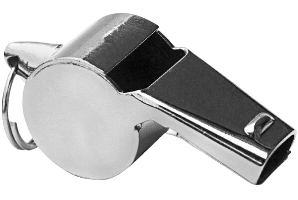
Whistle - A Whistle or Pea Whistle is a musical instrument often made of metal with a small Pea inside. When Air is blown into the mouthpiece, it causes the Pea inside to rattle and creates sound. The Whistle makes a high-pitched, piercing and shrill sound. Volume and Pitch are controlled by the amount air blown inside, with Notes lasting as long as air is blown into it.
Wind Instruments - A Wind instrument is a musical instrument that contains some type of resonator (usually a tube) in which a column of air is set into vibration by the player blowing into (or over) a mouthpiece set at or near the end of the resonator. The pitch of the vibration is determined by the length of the tube and by manual modifications of the effective length of the vibrating column of air. In the case of some wind instruments, sound is produced by blowing through a reed. Others require buzzing into a metal mouthpiece, while yet others require the player to blow into a hole at an edge, which splits the air column and creates the sound.
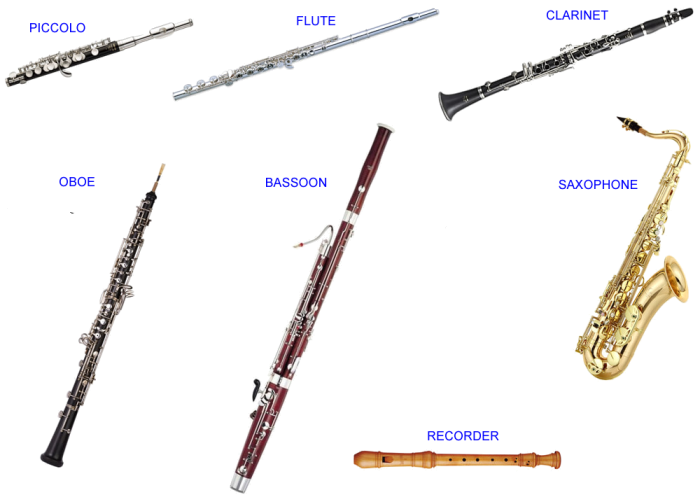
Wind instruments are typically grouped into 2 families, Brass instruments (Horns, Trumpets, Trombones, Euphoniums, Tubas) and Woodwind instruments (Recorders, Flutes, Oboes, Clarinets, Saxophones, Bassoons).
Woodwinds - Woodwind instruments are a family of musical instruments within the greater category of Wind Instruments. Common examples include Flute, Clarinet, Oboe, Bassoon and Saxophone. There are 2 main types of woodwind instruments are Flutes and Reed instruments. The main distinction between these instruments and other wind instruments is the way in which they produce sound. All Woodwinds produce sound either by splitting the air blown into them on a sharp edge, such as a fipple (e.g. flute, recorder), or by the coupled oscillation of one or two reeds and an air column (e.g. clarinet, bassoon). A Woodwind may be made of any material, not just wood. Common examples of other materials include brass, silver, cane, and other metals such as gold and platinum. The saxophone, for example, though made of brass, is considered a woodwind because it requires a reed to produce sound.
|





