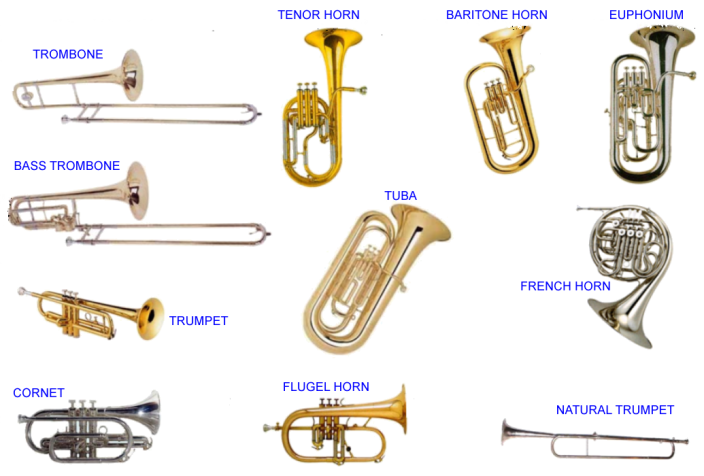
Valve - Brass instrument Valves are valves used to change the length of tubing of a brass instrument allowing the player to reach the notes of various harmonic series. Each valve pressed diverts the air stream through additional tubing, individually or in conjunction with other valves. This lengthens the vibrating air column thus lowering the fundamental tone and associated harmonic series produced by the instrument. Valves in brass instruments require regular maintenance and lubrication to ensure fast and reliable movement.
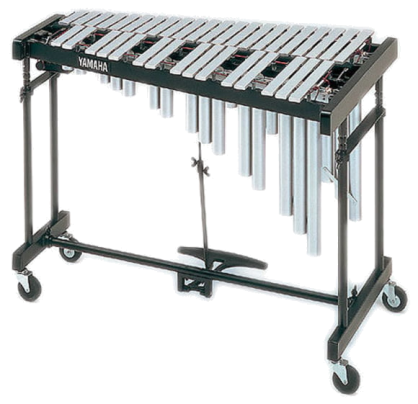
Vibraphone - The Vibraphone (also called the Vibraharp) is a percussion instrument in the metallophone family. It consists of tuned metal bars and is typically played by using mallets to strike the bars. A person who plays the Vibraphone is called a Vibraphonist, Vibraharpist or Vibist. One of the main differences between the vibraphone and other keyboard percussion instruments is that each bar suspends over a resonator tube containing a flat metal disc. These discs are attached together by a common axle and spin when the motor is turned on. This causes the instrument to produce its namesake tremolo or vibrato effect. The vibraphone also has a sustain pedal similar to a piano. When the pedal is up, the bars produce a muted sound; when the pedal is down, the bars sustain for several seconds or until again muted with the pedal.

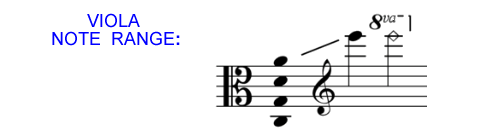
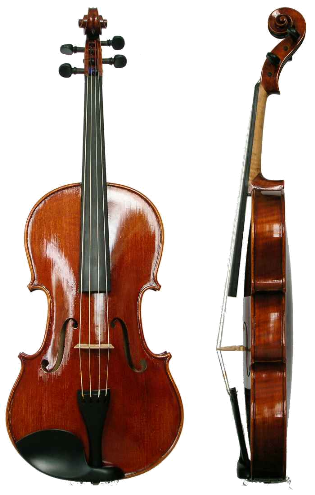
Viola - The Viola is a string instrument of the violin family and is usually bowed when played. The Viola is slightly larger than the violin and has a lower sound. Since the 18th century, it has been the middle or alto voice of the violin family, between the violin (which is tuned a perfect 5th higher) and the cello (which is tuned an octave lower). The strings from low to high are typically tuned to C3, G3, D4 and A4.
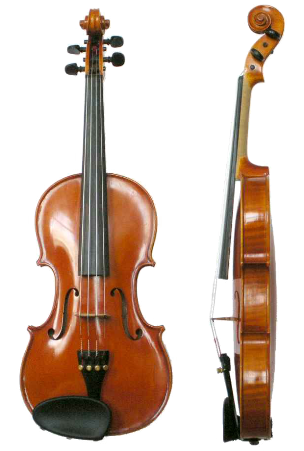
Violin - The Violin is sometimes referred to as a Fiddle and is a wooden chordophone. It is the smallest and highest-pitched instrument (soprano) in regular use in the Violin family. Smaller Violin-type instruments exist, including the Violino piccolo and the pochette, but these are virtually unused. Most Violins have a hollow wooden body and commonly have 4 strings but sometimes five strings. Commonly tuned in perfect 5ths with notes G3, D4, A4 and E5, and are most commonly played by drawing a bow across the strings. The Violin can also be played by plucking the strings with the fingers (pizzicato) and in specialized cases, by striking the strings with the wooden side of the bow.

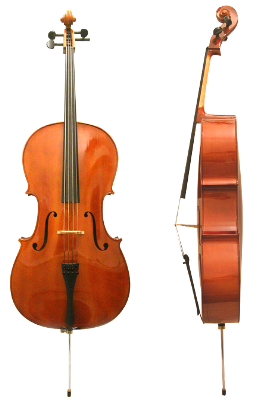
Violoncello - See Cello as the Violoncello is commonly abbreviated as Cello and is more common.
|





