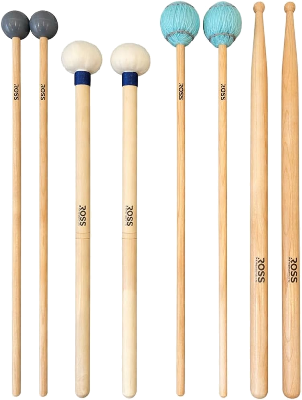
Mallets - A Mallet is an object used to strike a percussion instrument to produce its sound. The term drum stick is applied to a wide range of beaters. Some Mallets or beaters are normally used only with a specific instrument, while others are used on many different instruments. Often, Mallets of differing material and hardness are used to create different timbres on the same types of instrument.
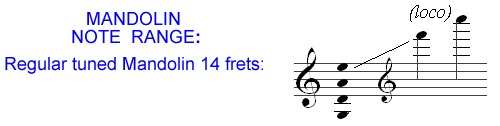
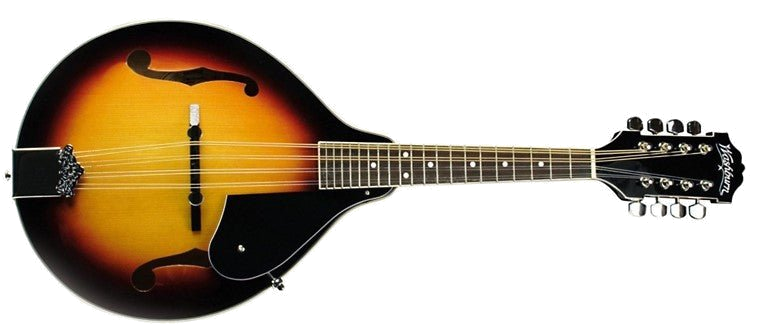
Mandolin - A Mandolin is a stringed musical instrument in the Lute family and is generally plucked with a pick. It most commonly has four courses of doubled strings tuned in unison for a total of eight strings. A variety of string types are used, with steel strings being the most common and usually the least expensive. The courses are typically tuned in an interval of perfect fifths, with the same tuning as a violin (G3, D4, A4, E5). There are many styles of mandolin, but the 3 most common types are the Neapolitan or round-backed Mandolin, the Archtop Mandolin and the Flat-backed Mandolin. The round-backed version has a deep bottom, constructed of strips of wood, glued together into a bowl. The archtop, also known as the carved-top mandolin, has an arched top and a shallower, arched back both carved out of wood. The flat-backed mandolin uses thin sheets of wood for the body, braced on the inside for strength in a similar manner to a guitar. Each style of instrument has its own sound quality and is associated with particular styles of music.
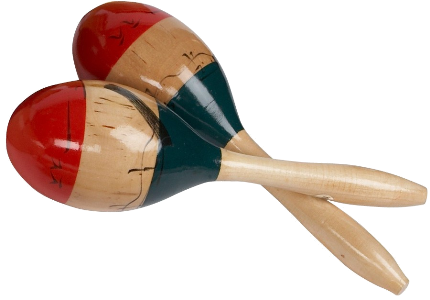
Maracas - A Maraca, sometimes called shaker or chac-chac, is a rattle that appears in many genres of Caribbean and Latin music. It is shaken by a handle and usually played as part of a pair. A maraca player in the Spanish language is called a maraquero. The Maraca produces sound through the shaking motion, which causes the internal elements to strike against the container's interior. It plays a primarily rhythmic role, accentuating the beat in various musical styles.
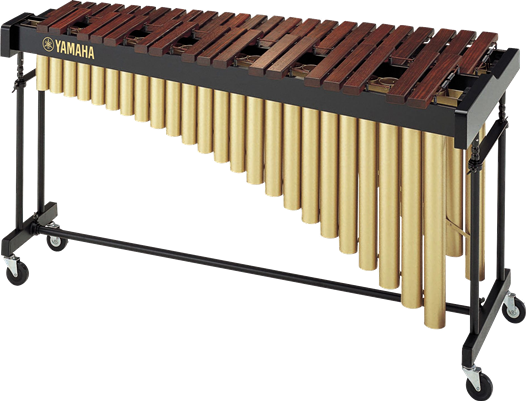
Marimba - The Marimba is a musical instrument in the percussion family that consists of wooden bars that are struck by mallets. Below each bar is a resonator pipe that amplifies particular harmonics of its sound. Compared to the xylophone, the Marimba has a lower range. Typically, the bars of a Marimba are arranged chromatically, like the keys of a piano. The marimba is a type of idiophone.

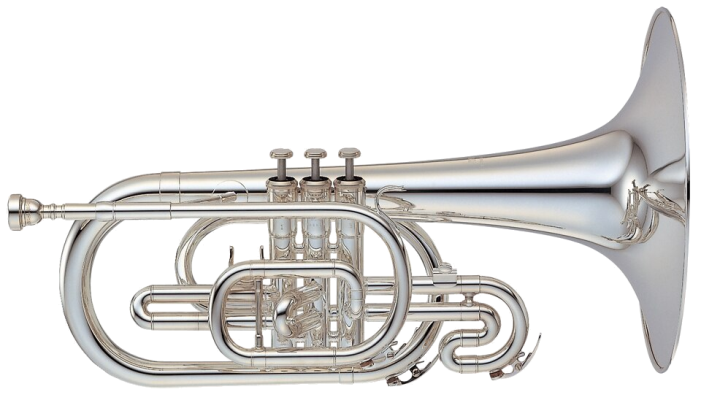
Mellophone - The Mellophone is a brass instrument used in some marching bands in place of French horns. It is a middle-voiced instrument, typically pitched in the key of F, though models in Eb, D, C, and G (as a bugle) have also historically existed. It has a conical bore and piston valves, like that of the euphonium and flugelhorn. These instruments are used instead of French horns for marching because their bells face forward instead of to the back (or to the side), as dissipation of the sound becomes a concern in the open-air environment of marching. Tuning is done by adjusting the tuning slide and/or the first valve slide. Fingerings for the mellophone are the same as fingerings for the Trumpet, Tenor Horn, and most valved brass instruments. Owing to its use primarily outside concert music, there is little solo literature for the mellophone other than that used within drum and bugle corps, and a single concerto written for the instrument.

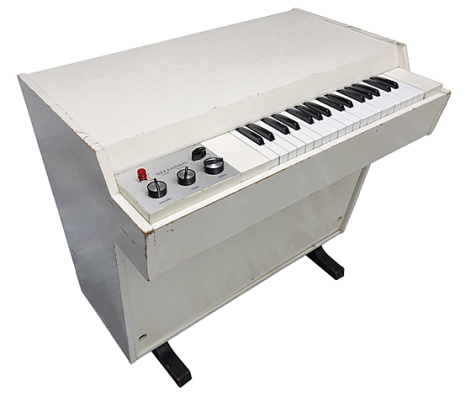
Mellotron - The Mellotron is an electro-mechanical musical instrument developed in Birmingham, England, in 1963. It is played by pressing its keys, each of which causes a length of magnetic audio tape to contact a capstan, which pulls it across a playback head. As the key is released, the tape is retracted by a spring to its initial position. Different portions of the tape can be played for different sampled sounds such as Choir and String Orchestra. It was adopted by rock and pop groups in the mid to late 1960's. One of the 1st pop songs featuring the Mellotron was Manfred Mann's "Semi-Detached, Suburban Mr. James" in 1966. The Beatles used it on tracks including the hit single "Strawberry Fields Forever" in 1967. Production of the Mellotron M-400 ceased in 1986, but it regained popularity in the 1990s and was used by bands such as Oasis, the Smashing Pumpkins, Muse, and Radiohead. This led to the resurrection of the original manufacturer, Streetly Electronics. In 2007, Streetly produced the M4000, which combined the layout of the M-400 with the bank selection of earlier models.
Membranophone - A Membranophone is any musical instrument which produces sound primarily by way of a vibrating stretched membrane. The sound is produced by a membrane ["skin" or "head"] stretched over an opening. Most, but not all, membranophones are generally called Drums. They are classified according to material, if it's single or double headed, shape, skin(s), skin fastening, playing positions, and manner of playing. Examples include the Timpani or Kettle Drum.
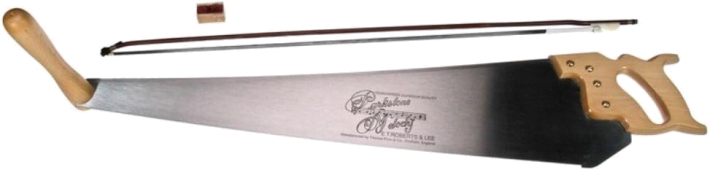
Musical Saw - The Musical Saw is a flexible handsaw played by holding the handle between the knees and bending the blade while bowing along the flat edge. The Musical Saw is found in the folk music of Russia and rural America, and is a popular vaudeville instrument. The Saw is generally played while seated, with the handle, called a tip-handle or cheat, squeezed between the legs and the far end held with one hand. Some sawists play standing, either with the handle between the knees and the blade sticking out in front of them. The saw is usually played with the serrated edge, or "teeth," facing the body, though some players face them away. Some saw players file down the teeth, which makes no discernable difference to the sound. To sound a note, a sawist first bends the blade into an S-curve. The parts of the blade that are curved are dampened from vibration and do not sound. At the center of the S-curve, a section of the blade remains relatively flat. This section, known as the "sweet spot," can vibrate across the blade's width, producing a distinct pitch: the wider the section of the blade, the lower the sound. Sound is usually produced by drawing a bow across the back edge of the saw at the sweet spot or, alternatively, by striking the sweet spot with a mallet.
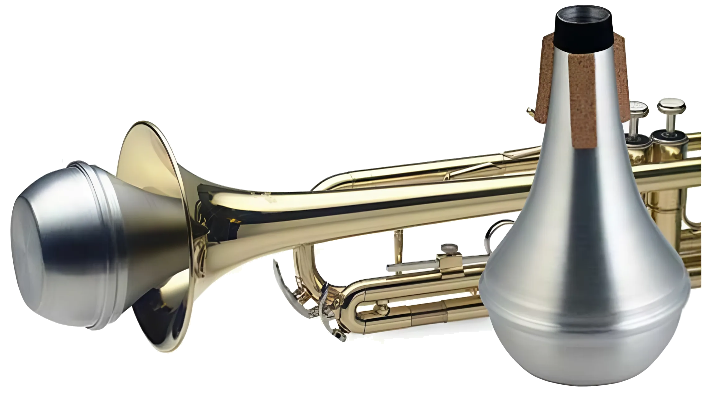
Mute - A Mute is a device attached to a musical instrument which changes the instrument's tone quality (timbre) or lowers its volume. Mutes on brass instruments are typically inserted into the flared end of the instrument bell. They can also be held in front of or clipped onto the bell. Of brass mutes, the "straight mute" is the most common and is frequently used in classical and jazz music, but a wide variety are available.
|





